
Materials Testing and Modeling
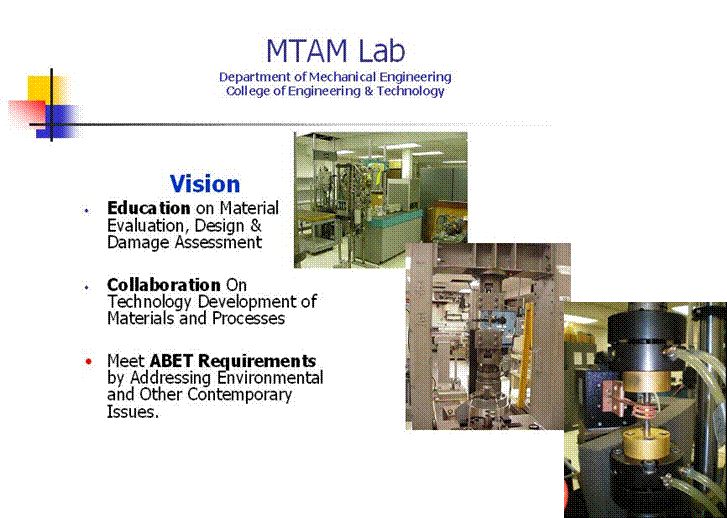
Lab - This is a fatigue testing facility that was established
in 2001, in the Department of Mechanical Engineering, as a result of a DOE ERLE
(Energy Related Lab Equipment) grant. The lab was established to serve educational
and academic research needs as well as collaborative research and service in
the area of materials testing, characterization and development of materials
constitutive models.
CAP
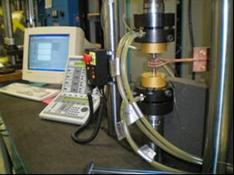
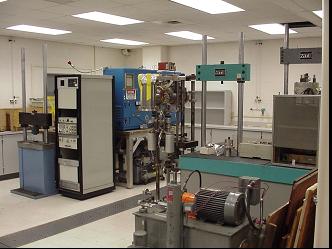
The lab currently contains several fatigue
test cells of different capacities. The following are tests that can be run in
the lab:
1. 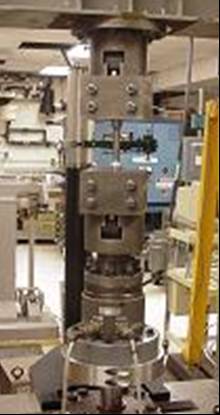 Low
Cycle Fatigue (LCF) with either Load or Strain control. Uniaxial or Biaxial
(axial plus torsion loading)
Low
Cycle Fatigue (LCF) with either Load or Strain control. Uniaxial or Biaxial
(axial plus torsion loading)
2. High
Cycle Fatigue (HCF) with either Load or Strain control. Uniaxial or Biaxial
(axial plus torsion loading)
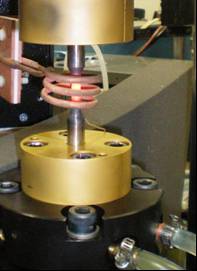
3. Thermo-Mechanical
Fatigue (TMF) at temperatures up to 1100 deg-C.
4.  Crankshaft
Testing
Crankshaft
Testing
For more details on existing capabilities,
please contact the Lab
Director, Dr. Abou-Hanna (X2725)
Class Use – Lab Activities:
Class lab activities need to be scheduled at least 8 weeks in advance in order to ensure proper preparation of equipment for the specific lab exercises. It is assumed that for such lab activities the faculty member and/or the teaching assistants will be the users of the equipment. Consequently, they need to go through training. If you have such needs, the first step would be to complete the User Application form, and follow the General Procedure outlined below.
Operating Guidelines for Users
General Procedures:
- Discuss test needs, sample type, test type, and understand what equipment options are available for your needs with the Lab Director, Dr. Abou-Hanna (X2725).
- Complete a User Application form and submit it to Dr. Abou-Hanna.
- Discuss and schedule for training on the specific test cell for the specific test. The trainer will be identified by the Lab Director, depending on the type of test and the equipment.
- Read and follow Safety Procedures
- Have the trainer set up and run one test.
- Make sure the Chiller system is turned on
- Make sure that the cooling system is hooked up to the pump.
- Follow operating procedures of the specific test equipment.
- Keep a log of all the calibration data on the onset of each test.
- Notify Dr. Abou-Hanna of the test schedule and make sure that you have another person present in the lab when you are conducting the experiment.
- Keep all tools and personal belongings away from test cell.
- DO NOT LEAVE THE TEST UNATTENDED UNTIL you are sure that the test is running smoothly, and the controller interlocks and safety features are all activated.
- If you are running a test, turn on the red light (coming soon) located on top of the entrance door to indicate that equipment is running and lab entry must be authorized by the Lab Director.
- Users need to check in and out by
using the log sheet posted on the Lab door.
Safety:
For Safety guidelines, refer to Safety Rules for MTAM Lab.
Maintenance:
Report any maintenance issues such as malfunctioning
equipment and hydraulic fluid or water leaks to Dr. Abou-Hanna at
677-2725. In case of an emergency, or if
you cannot reach Dr. Abou-Hanna, contact Mr.
Alterations and Upgrades:
Alterations and modifications to equipment require prior approval from the Lab Director.
Lab Charges and Rates:
Lab use for projects that involve external agencies will require a financial arrangement. The rates depend on many factors, mainly test period & test type. The Lab Director will provide the user an estimate of cost based on University sanctioned rates.
Academic use for projects that are not funded and are not for external clients carries no charge.
Lab Access:
Use of the facilities needs to be arranged by completing a User Application form. The user is expected to use only the equipment agreed upon in the User Application form. If additional equipment is required, then the user needs to contact the Lab Director and request an amendment to the initial agreement.
Hours of Use: The work in the lab must be during normal hours 8:-5: to ensure the personnel are available in case of an emergency or equipment malfunction. Special arrangements can be made if working after-hours is required, and the project faculty advisor will need to assume responsibility and be familiar with the test and the equipment and supervise the work. Fatigue tests may go on for days at a time, and they may require frequent monitoring by users. In such case, users should be able to enter the lab after hours ONLY to monitor and record data.
Reporting Problems:
Report problems to the Lab Director. In case of emergency, contact Mr.
Lab Director Contact Information:
Jeries Abou-Hanna
Jobst 106
(309) 677-2725